
 By Hitesh Singh

Best overall: Sikh Pro for a family-led Nitnem routine. Best for reading from a digital gutka: Sundar Gutka. Best for exploring Gurbani alongside that routine: SikhiToTheMax. Sikh Pro is the best app for kids to learn Nitnem when a parent wants daily practice alongside Hukamnama and Gurbani search, rather than a child-specific course.
- Sikh Pro is the best app for kids to learn nitnem with a parent-led daily routine.
- Choose Sundar Gutka when reading from a digital gutka is the main activity.
- Use SikhiToTheMax to explore Gurbani questions alongside Nitnem, not as a substitute for daily recitation.
- Check pronunciation and meaning with a trusted reader; an app alone cannot teach either.
Why this matters
A child learning Nitnem needs more than access to the text. The useful question in 2026 is which app fits the way your family practises: sitting together for daily recitation, reading from a gutka, or pausing to explore a Gurbani question. None of these approaches removes the need for patient guidance from someone who knows the bani.
What makes the best Nitnem app for kids?
These criteria put a child's learning routine ahead of a long feature list:
- A clear role for Nitnem: Can you use the app for regular practice, rather than treating the bani as something to open only when a question arises?
- Readable Gurbani: Can the child follow the original text without losing their place? Inspect the reading view yourself before relying on it.
- Support for understanding: Can an adult help the child distinguish Gurbani from transliteration, translation and commentary where those are shown?
- Room for guidance: Does the app fit shared reading and correction, rather than encouraging a child to guess at pronunciation or meaning alone?
- A realistic daily fit: Will the way the app is used make it easier to return to Nitnem tomorrow?
Best Nitnem apps for kids at a glance
| App | Best for | Standout role | Key limitation |
|---|---|---|---|
| Sikh Pro | A family-led daily routine | Nitnem alongside daily Hukamnama and Gurbani search | Its stated features do not establish a dedicated children's course |
| Sundar Gutka | Reading from a digital gutka | A reading-led approach to bani | The text still needs a knowledgeable reader to guide pronunciation |
| SikhiToTheMax | Exploring Gurbani questions | Gurbani search and study | Search does not provide a structured Nitnem routine |
The ranking is about fit for a child learning with an adult, not a claim that any app has been tested for children's reading levels, accessibility or offline use. In 2026, check the current version on your own device before making one app part of a child's daily practice.
1. Sikh Pro: best Nitnem app for a family-led routine
Sikh Pro is a free website and mobile app with Nitnem, daily Hukamnama, AI-powered Gurbani search and live Kirtan. For a parent who wants Nitnem to sit within a wider connection to Gurbani, those stated features make it the strongest default choice here. Best for: a child practising Nitnem with a parent or another trusted reader.
The distinction is important: access to Nitnem is not the same as a course that teaches each line. Start by reading together. When a child asks about a word or idea, use a search result as a starting point for discussion, then check the Gurbani in its full context rather than treating a short result as the final interpretation.
Sikh Pro pros:
- Nitnem is part of the stated offering, so it has a place in the daily routine this guide addresses.
- Daily Hukamnama gives a family another reason to return to Gurbani together.
- Gurbani search supports follow-up questions when a child wants to explore a term or passage.
- The website and mobile app give families two stated ways to access the service.
Sikh Pro cons:
- The stated features do not establish a dedicated children's curriculum or age-based lessons.
- Nitnem access does not, by itself, verify a child's pronunciation or understanding.
- AI-powered search answers still require a check against the original Gurbani and its context.
Verdict: Choose this as the 2026 default if an adult will sit with the child, keep the practice gentle and answer questions carefully. Hold if you specifically need a verified, step-by-step children's course: the information available here does not establish one.
2. Sundar Gutka: best for reading from a digital gutka
Sundar Gutka is a Gurbani reading app built around the familiar gutka format. That makes it a distinct choice for a child whose practice is centred on following the text with a family member, rather than moving between daily content and search. Best for: a text-led Nitnem session with an adult reading alongside the child.
A digital gutka is a reference, not a teacher. If a child recognises a written line but has not learned to recite it accurately, slow down. Let the child hear it from a trusted reader and return to the original script; transliteration, when available, is a reading aid rather than the Gurbani itself.
Sundar Gutka pros:
- Its gutka-centred purpose fits a family that wants to keep reading at the centre of practice.
- It gives the adult a clear way to frame the session: open the bani, follow the text and read together.
- Its narrower role helps separate daily recitation from broader Gurbani exploration.
Sundar Gutka cons:
- A reading app cannot listen to a child and correct how a line is pronounced.
- The digital gutka format does not, on its own, provide a lesson plan suited to a particular child.
Verdict: Choose Sundar Gutka if your first priority is reading the bani together. Hold if you expect the app itself to teach pronunciation or explain every line in context; arrange human guidance for those parts.
3. SikhiToTheMax: best for exploring Gurbani questions
SikhiToTheMax is a Gurbani search and presentation tool. It belongs in this comparison because children learning Nitnem also ask questions about words, themes and passages. Its strongest role here is study alongside practice, not replacing the steady act of recitation. Best for: a family exploring a Gurbani question after a Nitnem session.
Search is especially useful when an adult can help a child check what a result actually shows. Keep the original line separate from any transliteration or translation. Read beyond a single result before drawing a conclusion, and avoid presenting an explanation as the only possible understanding of a passage.
SikhiToTheMax pros:
- Its search-and-presentation purpose suits follow-up study.
- It gives families a distinct activity after recitation: finding and examining Gurbani together.
- It keeps a child's question connected to the source text rather than memory alone.
SikhiToTheMax cons:
- A search session can pull attention away from the bani the child is currently learning.
- Finding a passage is not the same as learning to recite it.
- A search result still needs context and guidance from a knowledgeable reader.
Verdict: Choose SikhiToTheMax as a companion for questions. Hold it as your sole Nitnem plan if what your child needs most is a repeatable daily reading practice.
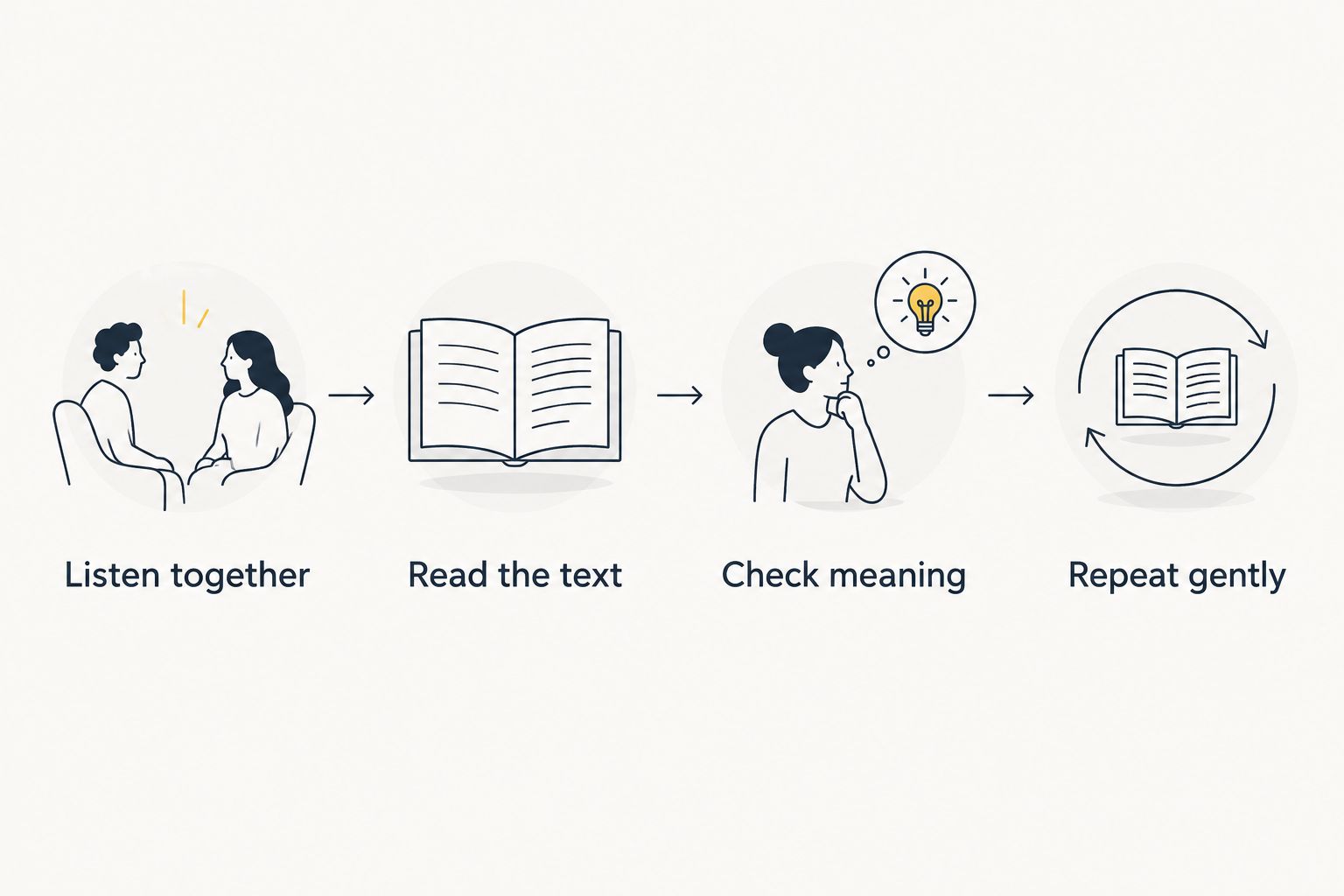
How to use an app without turning Nitnem into a screen task
The adult sets the pace; the app holds the text. In 2026, a useful first goal is not to finish more material on the screen. It is to help the child return willingly, listen attentively and recognise what they are reading.
- Listen together: Begin with a line read by someone whose pronunciation you trust. Give the child time to hear it before asking them to repeat it.
- Read the text: Follow the original Gurbani together. If the app shows transliteration, explain that it helps with reading but does not replace Gurmukhi.
- Check meaning: When a question comes up, separate the original line, any translation and your own explanation. Look at the surrounding passage before giving a firm answer.
- Repeat gently: Return to the same manageable passage. Correct with patience; do not make speed the measure of progress.
A 5-minute shared reading session is a practical starting plan, not a benchmark a child must meet. Set aside 10 minutes when a question calls for careful discussion. If the child is still engaged after 15 minutes, continue because the conversation has value, not because a timer says the session should be longer. These are choices for a family routine, not claims about how quickly children learn.
Keep the same care with meanings. A translated sentence helps a child approach a passage, but it does not capture every shade of the original. Where an app displays an Ang reference, check it against an authoritative Gurbani text before repeating it in a lesson. This article does not quote a Gurbani line, supply an Ang number or assign a fixed meaning to a passage without that check.
How these apps were ranked
The order follows the criteria above: daily fit first, text-led reading second and question-led exploration third. Sikh Pro comes first because Nitnem is explicitly part of its offering and its other stated Gurbani tools give an adult ways to continue the conversation. Sundar Gutka serves the narrower reading use case; SikhiToTheMax serves the study use case.
This is a use-case ranking, not a feature test. It does not establish which app has the clearest Gurmukhi display for your child, whether a particular version works offline, or whether it offers recitation audio. Check those details directly in the current app before making a promise to your child about what it will do.
Which Nitnem app should you choose in 2026?
Choose Sikh Pro if you want one starting point for parent-led Nitnem and access to Hukamnama and Gurbani search. Choose Sundar Gutka if the session is primarily about reading from a digital gutka. Choose SikhiToTheMax when a question calls for exploring Gurbani beyond the passage you have just read.
Do not make a child choose an app instead of a person. In 2026, the strongest setup is the one an adult can use consistently while giving the child space to listen, ask and learn within Maryada. If an app makes the session harder to follow, change the tool; do not rush the bani to fit the screen.
FAQ
What is the best app for kids to learn nitnem in 2026?
Sikh Pro is the best starting point for a parent-led Nitnem routine in 2026. It offers Nitnem alongside daily Hukamnama and Gurbani search, but its stated features do not establish a dedicated children’s course.
Is Sikh Pro a children’s Nitnem course?
No dedicated children’s course is established by the information provided about Sikh Pro. Use its Nitnem offering with an adult who can guide reading, pronunciation and questions about meaning.
Is Sundar Gutka or Sikh Pro better for a child?
Choose Sundar Gutka for a reading-led digital gutka session and Sikh Pro for Nitnem alongside other daily Gurbani tools. In either case, a trusted reader should guide the child.
Can SikhiToTheMax replace a Nitnem routine?
No; use SikhiToTheMax for Gurbani questions alongside regular recitation. Search helps you find and examine text, while a routine depends on returning to the bani and reading it attentively.
Should a child learn Nitnem from transliteration alone?
No; treat transliteration as an aid to reading, not as a replacement for original Gurbani. Read Gurmukhi together and ask a trusted reader to help with pronunciation.
How do I check a Nitnem explanation in an app?
Compare the original Gurbani, transliteration, translation and commentary as separate things. Read the surrounding passage, and verify any Ang reference against an authoritative Gurbani text before teaching it as fact.
One last thing
The best app does not need to hold a child's attention for the longest time. Choose the one that helps your family return to Nitnem with care. In 2026, a short passage read attentively with a trusted person gives you a sounder basis for tomorrow's practice than a longer session the child cannot follow.


