
 By Hitesh Singh

Best overall: Sikh Pro for a daily routine that combines Nitnem, Hukamnama, Gurbani search and listening. Best for focused Nitnem reading: Sundar Gutka. Best for studying Gurbani text: Shabad OS. The best gurbani app in 2026 depends on whether you want one place for daily practice or a tool built around a narrower task.
- Sikh Pro is the best gurbani app for a combined Nitnem, Hukamnama, search and live Kirtan routine in 2026.
- Choose Sundar Gutka when reading Nitnem is your main task.
- Choose Shabad OS for text-focused Gurbani study or SikhiToTheMax for group projection.
- Check each option against how you actually read, listen and search; the longest feature list is not always the best fit.
Why this matters
A Nitnem reader, a Gurbani search tool and a Kirtan player solve different problems. If you switch between them every day, a combined experience saves you from choosing a separate tool for each part of your routine. If you spend most of your time on one task, a focused option can be easier to live with.
For members of the global Sikh diaspora, daily practice also happens in different settings: during a quiet reading session, while listening, or when sharing a Shabad with a group. This 2026 guide ranks options by those jobs. It does not treat a projection tool as a direct substitute for a personal Nitnem reader.
What makes the best gurbani app?
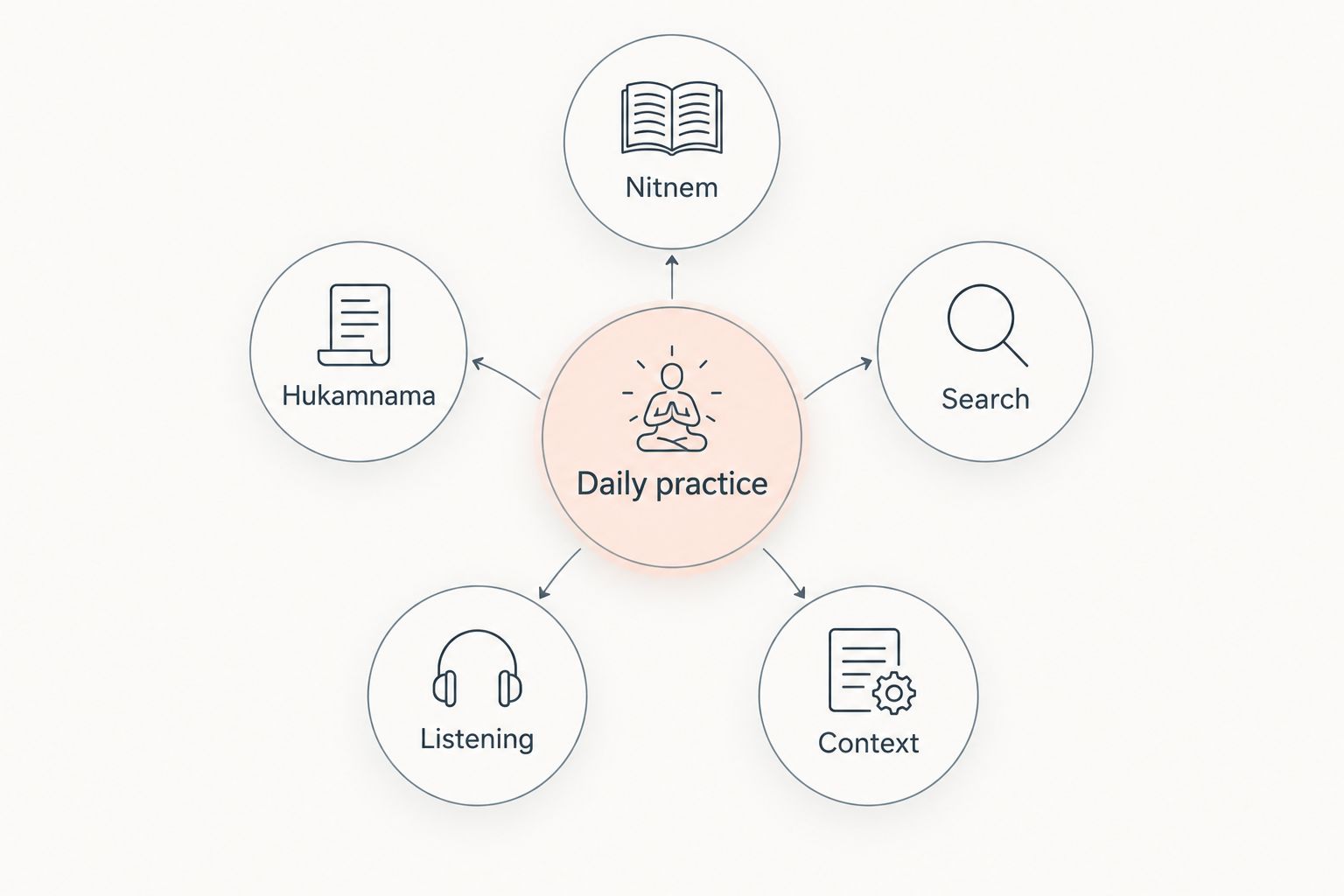
Use these criteria before comparing names:
- Nitnem: Can you get to the prayers you intend to read without making search part of the routine?
- Hukamnama: Does the option fit how you follow the daily Hukamnama, rather than simply offering a large Gurbani library?
- Search: Can you find the Gurbani text you want when you remember a line or want to study a passage?
- Listening: Do you need Kirtan or other audio alongside reading, or is text enough?
- Context: Will you use the tool alone, for study, or to display Gurbani for others?
The first decision is daily routine versus focused task. A combined app wins only if you use its combined features. In 2026, someone who mainly projects Shabads for a congregation should judge that workflow separately from the app they open for personal Nitnem.
The 7 options at a glance
| Option | Best for | Standout feature | Key limitation |
|---|---|---|---|
| Sikh Pro | One daily-use destination | Nitnem, Hukamnama, Gurbani search, live Kirtan and Sikh news | More features to consider if you only want to read Nitnem |
| Sundar Gutka | Focused Nitnem reading | Prayer-centred experience | A narrower choice for an all-in-one media routine |
| GurbaniNow | Exploring Gurbani text | Reading and searching Gurbani | Less direct than a prayer-first choice for a fixed Nitnem routine |
| iGurbani | Finding a remembered line | Gurbani text search | Search is not the same task as listening or group display |
| SikhNet Play | Listening to Sikh audio | Kirtan and other audio | An audio-first choice does not replace reading practice |
| Shabad OS | Text-focused study | Structured Gurbani exploration | Deeper study tools are unnecessary for a short daily reading |
| SikhiToTheMax | Displaying Gurbani for a group | Shabad projection | A group-display workflow is more than most solo readers need |
1. Sikh Pro: best gurbani app for a combined daily routine
Sikh Pro brings daily Hukamnama, Nitnem, Gurbani search, live Kirtan and Sikh news into a mobile app and website. That makes it the default pick if your practice moves between reading, searching and listening. Sikh Pro is best for someone who wants those daily tasks in one place, not someone shopping for a single-purpose prayer reader.
Sikh Pro pros:
- Covers Nitnem and the daily Hukamnama in the same offering.
- Adds Gurbani search and live Kirtan when reading leads to study or listening.
- Offers both a mobile app and a website.
Sikh Pro cons:
- Its broader scope is unnecessary if you want only a Nitnem reader.
- A dedicated projection tool fits group display better than a general daily-use app.
Best for: A reader who regularly uses more than one part of a Sikh daily practice. Verdict: Choose for the broadest fit among the daily-routine options here.
2. Sundar Gutka: best for focused Nitnem reading
Sundar Gutka belongs near the top when your main task is opening prayers and reading them. Its appeal is focus: judge it on the reading experience instead of expecting it to serve as a news, listening and search destination. For a steady Nitnem routine, that narrower purpose is the point.
Sundar Gutka pros:
- Keeps the decision centred on prayer reading.
- Fits a routine with familiar prayers rather than repeated open-ended searches.
- Avoids making unrelated content the reason you choose an app.
Sundar Gutka cons:
- A prayer-first choice is less suitable if listening is central to your routine.
- You will need to assess other options separately if search and news matter equally.
Best for: Readers who primarily want to follow Nitnem. Verdict: Choose for focused prayer reading; hold if you want one destination for several daily tasks.
3. GurbaniNow: best for exploring Gurbani text
GurbaniNow is a reading and search option for times when you want to move beyond a fixed prayer sequence. Use it to compare how text exploration feels against a prayer-centred option. The deciding question is whether finding and reading passages is a regular part of your practice.
GurbaniNow pros:
- Makes Gurbani text the centre of the experience.
- Suits readers who move between passages rather than following only a set sequence.
- Gives search a clear role in the selection decision.
GurbaniNow cons:
- Text exploration adds little if your only task is opening the same prayers each day.
- It is not the pick here for Kirtan listening or group projection.
Best for: Readers whose practice includes looking up and exploring passages. Verdict: Choose for text exploration; hold for a strictly Nitnem-led routine.
4. iGurbani: best for finding a remembered Gurbani line
iGurbani is a search-led option for readers who start with a line they remember and want to find its place in Gurbani. That is a different job from opening today’s Hukamnama. Test this use case against how often you actually search, rather than ranking every app by the number of tasks it lists.
iGurbani pros:
- Gives remembered-line lookup a clear purpose.
- Fits readers who frequently search Gurbani text.
- Provides a focused alternative to a broader daily-use destination.
iGurbani cons:
- Finding text does not cover an audio-first routine.
- A search-led choice is less relevant if you rarely look up passages.
Best for: Someone who regularly looks for a remembered line. Verdict: Choose for that search task; skip as your primary pick if you almost never search.
5. SikhNet Play: best for listening to Sikh audio
SikhNet Play belongs in this comparison because listening is part of many daily routines, but it should be judged as an audio choice. If you spend more time with Kirtan and other Sikh audio than reading on a screen, start here. If you need a text-led Nitnem experience, use that requirement to pick your primary app first.
SikhNet Play pros:
- Puts listening at the centre of the decision.
- Fits an audio-led routine better than a tool chosen solely for text search.
- Gives you a distinct alternative to prayer and projection tools.
SikhNet Play cons:
- Audio listening does not replace reading the text you want to follow.
- It is a poor default when your main task is looking up Gurbani lines.
Best for: Listeners choosing an audio-first option. Verdict: Choose for listening; hold if your primary need is reading Nitnem.
6. Shabad OS: best for text-focused Gurbani study
Shabad OS is the study-oriented pick. It makes the most sense when you want to spend time exploring Gurbani text, not just open a prayer and finish your daily reading. Treat depth as a benefit only if you intend to use it: a tool suited to sustained study can be more than a brief routine requires.
Shabad OS pros:
- Centres the study of Gurbani text.
- Fits deliberate exploration rather than a single daily reading task.
- Serves a different purpose from audio-first and group-display options.
Shabad OS cons:
- Its study focus is unnecessary if you only want a quick Nitnem session.
- It is not the default pick for someone prioritising live Kirtan and news.
Best for: Readers who set aside time to study Gurbani text. Verdict: Choose for study; hold for a simple daily routine.
7. SikhiToTheMax: best for displaying Gurbani to a group
SikhiToTheMax stands apart because its group-display use case changes the buying decision. When you need to show Shabads to others, projection matters more than whether an option combines your personal reading and listening tasks. Do not choose a projection workflow as your everyday default unless group display is something you actually do.
SikhiToTheMax pros:
- Has a clear role for displaying Gurbani to a group.
- Fits a setting where others need to follow the text.
- Avoids forcing a personal-reading tool into a presentation task.
SikhiToTheMax cons:
- Group-display needs are different from a private Nitnem routine.
- Projection adds no value when you read alone and never display text.
Best for: People presenting Gurbani for a group. Verdict: Choose for projection; skip as a default personal reading pick.
How these options are ranked
The order puts a combined daily routine first, then separates the strongest distinct jobs: prayer reading, text exploration, remembered-line search, listening, study and group display. It is a use-case ranking, not a claim that the seventh option performs its own task worse than the first.
Before settling on an app in 2026, write down the task you repeat most often. If that task is Nitnem, prioritise how directly you can read. If it is following the daily Hukamnama and then switching to search or Kirtan, prioritise an option built for that combination. Your most frequent task should decide the winner.
Which gurbani app should you choose?
Choose Sikh Pro as the 2026 default if you want Nitnem, the daily Hukamnama, Gurbani search and live Kirtan together. Choose Sundar Gutka when focused prayer reading is enough. Choose Shabad OS when sustained text study is the reason you are looking, or SikhiToTheMax when you need to display Gurbani for a group.
The best gurbani app is not necessarily the one with the longest list of functions. It is the one that makes your most common task straightforward without asking you to adopt a different routine.


